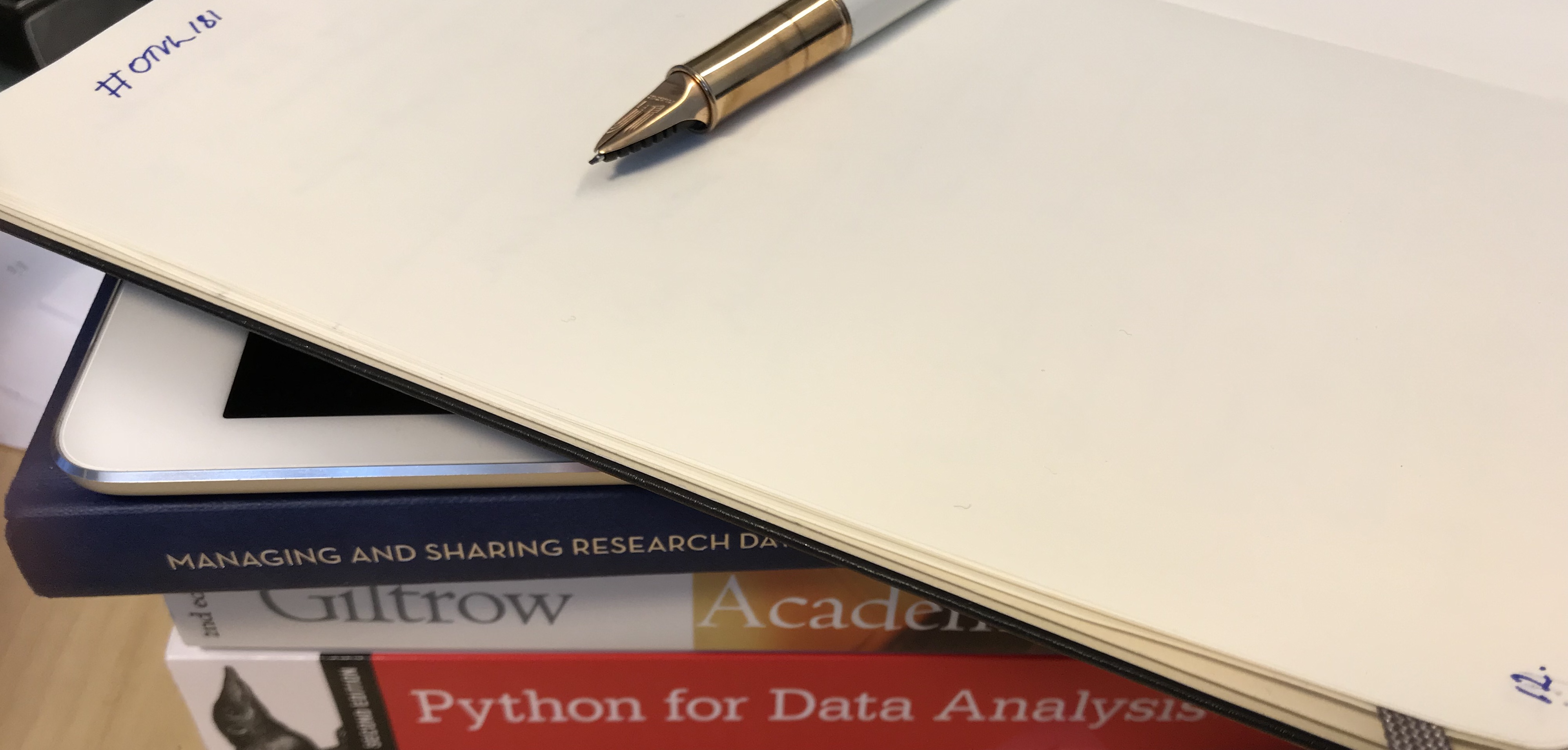
A couple of years back, when I started the job I still have, one of the first things that happened was that someone handed me
Mackey, T.P. & Jacobsen, T.E. (2014). Metaliteracy: reinventing information literacy to empower learners. London: Facet Publishing.
and told me I probably was interested. I certainly was, and I believe that was when I first became aware of the multitude of literacies that get discussed a lot. Most likely also the first time I heard about digital literacy. I had spent some time already with the concept of information literacy. Other literacies I’ve been thinking about lately are academic literacy and also data literacy. Somewhere in all those literacies I tend to get lost, feeling that it’s just so many words. But for the last couple of weeks I’ve spent a little time on digital literacy, and I did learn a few interesting things.
Some digital literacy scholars seem to consider information literacy as part of digital literacy. If you come to the subject from the other direction, this seems slightly upside down, since digital literacy, to me, is about how you relate to information no matter if this information is digital or not. However, I suspect this is mostly about where you start. If you want to understand where academic librarians tend to start, the ACRL Framework for information literacy in higher education can be a starting point as good as any. This framework discusses information literacy as it relates to the following points:
- Authority Is Constructed and Contextual
- Information Creation as a Process
- Information Has Value
- Research as Inquiry
- Scholarship as Conversation
- Searching as Strategic Exploration
This blog post, is not mainly about information literacy though. (Or it wasn’t supposed to be.) This should be about digital literacy.
In order to better understand the concept of digital literacy, I tracked down a literature review where they explored three types of definitions of digital literacy.
Spante, M., Sofkova Hashemi, S., Lundin, M., Algers, A., & Wang, S. (2018). Digital competence and digital literacy in higher education research: Systematic review of concept use. Cogent Education, (manuscript just accepted). doi:10.1080/2331186x.2018.1519143
As I understand it, these three types can be considered as building on each other, starting with digital literacy, evolvning into digital literacies and finally becoming critical digital literacies. The definitions used by researchers tended to be based in either policies (just like I did above, by adding a link to the information literacy framework) or to more research based definitions. I found it interesting to see how these evolving definitions seemed to take digital literacy closer to the aspects of information literacy that has always interested me most, That is, how do information seekers actually use the information they find. What do you need in order to find AND USE information in a meaningful way? Perhaps I should understand digital literacy as basically the same, but focusing on using online retrieval and redistribution of information.
I must admit reading about digital literacy has made me a little bit confused. My preconceived ideas would have made it different from information literacy by saying that digital literacy was focused and defined by mode of distribution, whereas information literacy was focused and defined by the goal of integrating new information into one’s knowledge. However, the more I’ve been reading on the subject, the more the lines seem to blur. Also, the choice of term seems to depend a lot on in which discipline the discussion is going on.

 Intercalat-ed
I suppose that one of confusing part is, as you also mention, that it’s hard to draw a clear line between all kinds of ‘literacies’. There is also media literacy and ICT literacy to make it more confusing.
LikeLike
and visual literacy, mobile literacy, academic literacy (sometimes related and sometimes perhaps not) and a few more 🙂 which one you choose somehow seems to say something about what you consider the most important, or defining, aspect of the questions. (On the other hand, sometimes I think I’m to obsessed with definitions. My math background is showing up perhaps. In math, definitions are necessary. Social sciences on the other hand… well, it works differently.)
LikeLike
All these literacies! In almost all areas, one needs to be literate to understand. I teach health literacy, which is very important in order to understand your health, when you need to understand your diagnosis for example or something “as simple” as understanding what two tablets daily means. A limited health literacy can be devastating and may be shameful. Please see this clip https://www.youtube.com/watch?v=BgTuD7l7LG8
I think of a limited digital literacy may also feel shameful in today’s society and that we as teachers need to understand that not all colleagues and students have a high degree of digital literacy just because they work at university or study (which most often means the use of computer, internet etc.)
/Lina Nilsson
LikeLike