Groups, rings and fields (?)

The third topic for ONL181 was called Learning in communities – networked collaborative learning. The name of the topic, and the thoughts I had around the suggested readings, implies that learning is something better done in a social setting. I really haven’t read enough on the topic, but somehow I’m not entirely comfortable with that thought. One of the suggested readings for the course, an article called Communities of practice and social learning systems: the career of a concept (Wenger, E. (2010). Communities of practice and social learning systems: the career of a concept. In Social learning systems and communities of practice (pp. 179-198). Springer, London.) Etienne Wenger explains learning as a social practice in a way that mostly makes sense to me. The communities of practice described in this article don’t necessarily define a field of knowledge in a collaborative process as I first thought, but this kind of collaborative work seems to require a lot of individual work too. In order to gain a sufficient understanding to have something to put into a collaborative effort a lot of thought and consideration is required. What I haven’t figured out just yet is how to work this into the group and social aspects of teaching that the rest of the suggested texts discussed. Group work doesn’t seem necessary for a community of practice to exist, though I suppose you could argue that collaborative learning in a group prepares you for interactions in a community of practice.

The discussions in my PBL group focused mainly on online group collaboration during this topic. My personal experience of group work is that it varies greatly. I’ve taken courses where work has been done in groups and it’s felt completely useless, and taken up a lot of energy. I’ve also taken courses where work done together with other has helped a lot, though in general I’ve preferred smaller groups or working with one other person (The PBL group for ONL181 has been quite an exception – this group has been fun to work with in spite of its size. But I’m still a little bit confused by the broad topics, short time periods and relatively little direction as this doesn’t really leave enough time to go very deeply.) For this to work, ideally I want to work with people I know well. The suggested texts for this topics confirmed my personal experience in that both the article by Brindley, Blaschke and Walti (Brindley, J., Blaschke, L. M., & Walti, C. (2009). Creating effective collaborative learning groups in an online environment. The International Review of Research in Open and Distributed Learning, 10(3).) and the text by Capdeferro and Romero (Capdeferro, N., & Romero, M. (2012). Are online learners frustrated with collaborative learning experiences?. The International Review of Research in Open and Distributed Learning, 13(2), 26-44.) emphasises how important the social interactions in a group are. The fact that online groups often consists of people that don’t know each other beforehand, combined with the awkwardness of some of the technical solutions used for online courses and the time restraints that come with some of the reasons people have to chose online studies can, I believe, be problems that needs to be considered before adding group work to an online course.

D3Orbits.svg-2.png
Image: An illustration of the group action of the dihedral group of degree 3 (D_3) on a set of 30 points equally spaced on a circle. Image created by Wikipedia user Jackkutilek, and used under a CC BY-SA license.

As for the PBL group work, a topic such as this became a little bit of a meta discussion. We also ran into a couple of technical problems after choosing a tool that neither allowed more than one person to work on the presentation simultaneously, nor provided sufficient backup services, but we did manage to get a presentation put together. Just remind me to always check how saving works and to make an extra backup, OK?


Failing to focus on essentials

The second topic of the ONL181 course was sharing and openness. This part of the course happened during a period when I was very busy at work, and I feel like I didn’t do my best at understanding everything here. I did read quite a bit, true. But my thought process took me not  where the suggested topics imply I should be, but rather focused on how we learn, what a course means and how to put things together.

The PBL group discussion ended up in a couple of different places, and we did learn a bit more about how to share using CC licenses. This is very practical knowledge, and even though I did know about CC licensing it is good to be reminded. I need to do the work too. And really, it isn’t hard to find images that can be used under a CC license. Attribution isn’t that hard either. We should all do it.

However, the group discussions wasn’t what had me thinking most during this part. I kind of got stuck on something in one of the suggested readings, namely a book called The battle for open by Martin Weller. As the author discusses context (or lack of context) as  difficulty for re-use of educational resources, he claims that

Arguably, content with clear boundaries, such as a sine wave function, can be easily separated and then re-embedded in other courses, where these connections are made, but this becomes more difficult for subjects with less well-defined bound- aries, for example taking a learning object about slavery from one context and embedding it elsewhere may lose much of the context required for it to be meaningful.

(Weller, M. (2014). The battle for open. London: Ubiquity Press. DOI: https://doi.org/10.5334/bam p. 70)

which spontaneously made me want to protest. It could seem like something simple as a sine function could easily be isolated and explained on its own. However, after having taught the basics of trigonometric functions more times than I really care to count, I’m not so sure. And I believe there is something to understand about how students construct knowledge, what students expect from a course and how courses, in general are designed that Weller is missing here, something that has bearing on how reusing content actually works. It’s mostly beside the point he is trying to make, and I’m sure others have pointed out similar things, but I haven’t seen an explanation of it. So let me try to explain what I see as the problem here:

A sine function is something that needs to be explained as a part of a math course including trigonometric functions. It can be used to model periodic phenomena. There’s a picture showing y=sin(x) in the header of this post. There are a number of pictures, exercises, interactive or just explained that can help students understand how it works. MathWorld has a pretty thorough explanation of the basics including a number of graphs that can be redrawn according to parameters chosen by the viewer. However, the explanation found there is far too complicated for the students I used to teach, and it wouldn’t be advisable to use it. My students had, for example, no knowledge of complex numbers, which would be needed to understand that page. In order to include a resource about the sine function in a course, I would have to check very carefully that my students had the right prerequisites to explain them. This would make finding resources very time consuming, but I suppose it could be done, and I could probably find a good resource at a more suitable level. This page doesn’t have much text but contains a very useful visualisation of the relation between trigonometric functions and the unit circle. It would have been a much better resource to use with my students, even though there are a couple of things that I would like to improve before using it. (The toggle between degrees and radians, the lack of gridlines or ticks for other angles than π/2 on the x-axis and 1 on the y-axis for example.) However, if I wanted to use this resource, I would still want to go carefully about it. Math students are usually working very close to a textbook. The course focus would be a textbook with exercises. Introducing a separate resource like this will cause confusion and/or not add very much unless it’s done deliberately. I would need to add questions and problems to solve with the help of this  resource. Those questions should preferably be phrased in a way familiar to the students. In short, it’s a lot of work for me as a teacher. A lot more than would be implied by the notion that a sine function is a small simple object that could easily be lifted out from and integrated to different courses. And in general, I think it is hard to single out pieces that can be turned into small neat educational resources to be reused within another course, at least within a subject as accumulative as mathematics. In fact, I think a module about slavery more likely to be re-usable, especially since students in the social sciences in general have more experience with handling multiple sources and voices in their course materials. But a key here is, perhaps, that a module about slavery would be a module, something that’s a bit larger than just a pretty picture of a function, and something that can be taken in as a whole. Because embedding small pieces in a way that works may actually be more work than creating small pieces that you can use yourself.


And as a PS, of course I know that the sine function in the quote was just an example, but it happened to be one I was quite familiar with. And I suspect that an argument similar to the one I just made can be created for many examples of small things many people would believe could be successfully lifted in and out of a course.


References and blogging – the troubles of a librarian

OK, so I’ve managed to do a couple of blog posts now. But the hardest thing so far is somewhat unexpected. How do I do references in a good way on a blog? Should I have a list of references at the end? Should I insert a full citation at every point I want to make a reference? Should I just add links? Links are not that nice, especially not when a subscription is required to read. Should I refuse to use non open access sources? And what then to do about print sources like books?

And please don’t tell the students I try to teach proper referencing about my problems. Or the researchers that ask me questions about reference management.

Or perhaps it’s OK that I don’t know. But any hints and tips for good practice would be appreciated.

A basic starting point

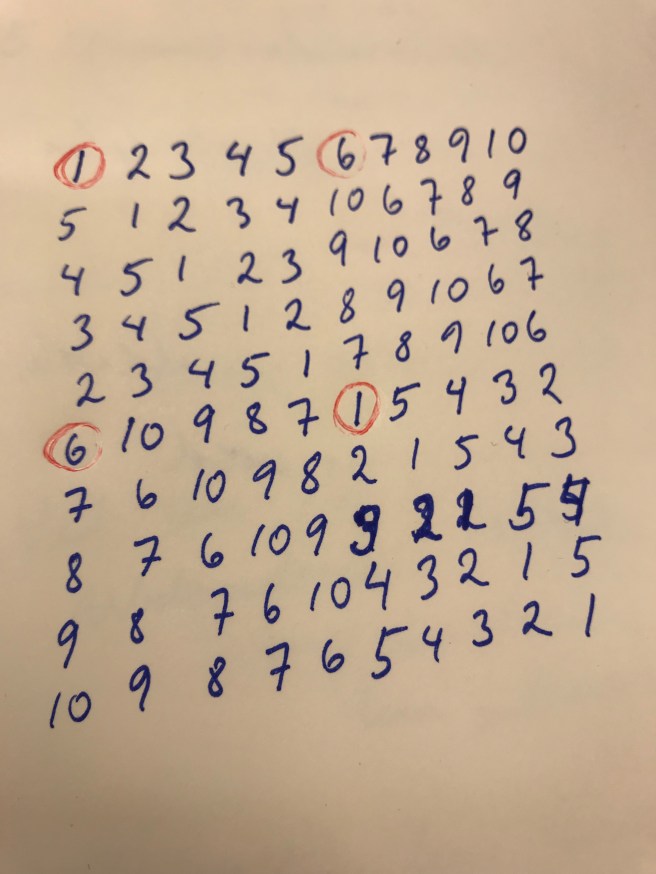
An intercalate is a set of four cells in a latin square such that they can be found in a total of two different columns, two different rows and contain a total of two different symbols.

I’ve marked one of the many examples with red in the picture below.

fullsizeoutput_25

If the term latin square is unfamiliar, just think of it as kind of a sudoku, but not entirely.

Dictonary.com defines intercalate as

intercalate
[in-tur-kuh-leyt]
verb (used with object), in·ter·ca·lat·ed, in·ter·ca·lat·ing.
1. to interpolate; interpose.
2. to insert (an extra day, month, etc.) in the calendar.

Origin of intercalate

1605–15; < Latin intercalātus past participle of intercalāre to insert a day or month into the calendar, equivalent to inter- inter- + calā- (stem of calāre to proclaim) + -tus past participle suffix
Related forms
in·ter·ca·la·tive, adjective
un·in·ter·ca·lat·ed, adjective
Synonyms

1. interject, introduce, insinuate.